
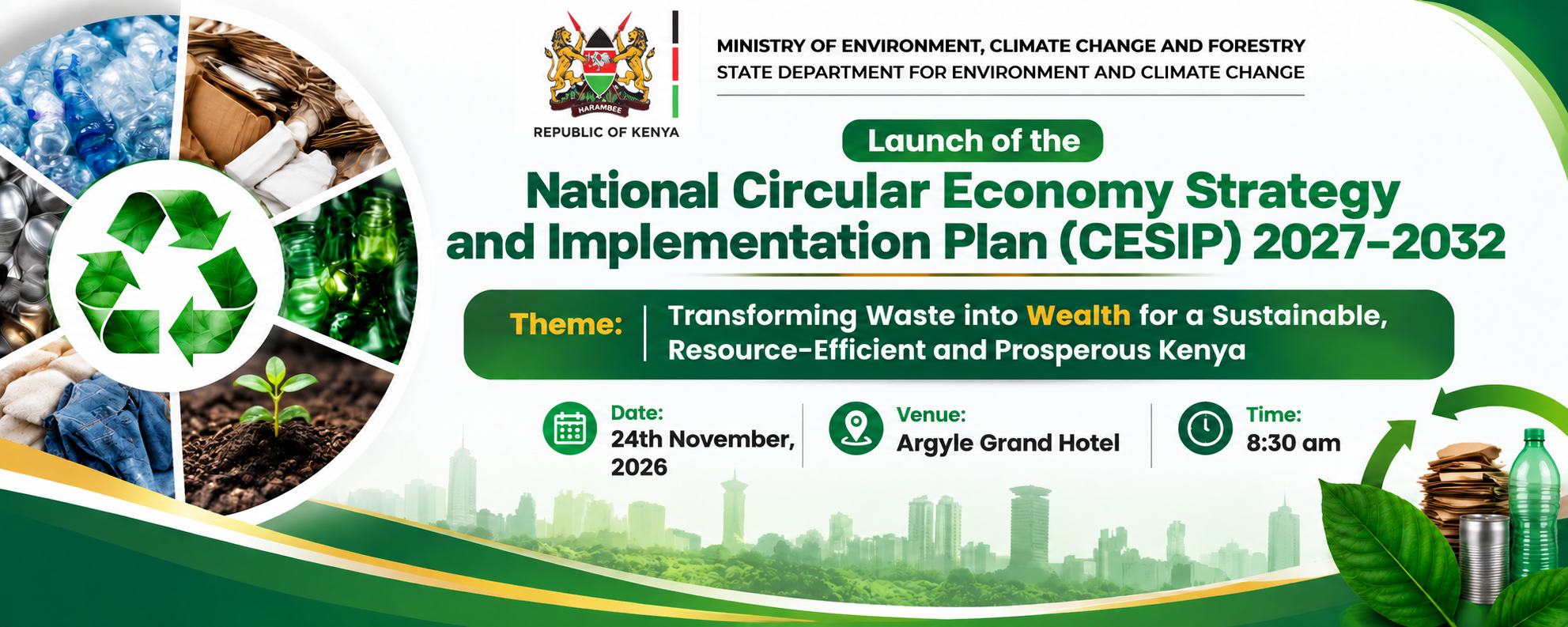
Kenya to launch national circular economy strategy and implementation plan 2027–2032
The Ministry of Environment, Climate Change and Forestry, through the State Department for Environment and Climate Change, will on 24th November 2026 launch the National Circular Economy Strategy and Implementation Plan (CESIP) 2027–2032, marking a significant step towards transforming waste management and promoting sustainable, resource-efficient economic growth.
The launch, scheduled to take place at Argyle Grand Hotel, Nairobi, from 8:30 a.m., will be held under the theme “Transforming Waste into Wealth for a Sustainable, Resource-Efficient and Prosperous Kenya.”
The strategy seeks to advance Kenya’s transition from a linear economic model, where resources are extracted, used and discarded, towards a circular economy that prioritises waste prevention, reuse, repair, recycling and the recovery of valuable resources from waste. By promoting circular production and consumption practices, the CESIP aims to strengthen resource efficiency, encourage innovation, create economic opportunities and reduce the environmental impacts associated with waste generation and disposal.
The circular economy presents an opportunity to reposition waste as a valuable resource capable of supporting enterprise development, job creation and sustainable livelihoods. Through improved waste recovery, recycling and reuse, materials that would otherwise end up in landfills or the environment can be channeled back into productive economic activities.
The implementation of circular economy principles can also stimulate investment in recycling infrastructure, support enterprises that use recovered materials, and strengthen value chains involving plastics, organic waste, electronic waste, textiles and other recyclable materials. These interventions are expected to contribute to a more resource-efficient economy while supporting environmental conservation and sustainable industrial development.
The strategy aligns with Kenya’s broader efforts to strengthen sustainable waste management and promote responsible production and consumption. Effective implementation will require coordinated action by national and county governments, the private sector, manufacturers, investors, waste management enterprises, development partners and communities.
Particular emphasis will be needed on strengthening waste segregation at source, improving collection and recycling systems, promoting sustainable product design and encouraging businesses to adopt circular business models. Public awareness and community participation will also be essential in fostering responsible consumption, reducing waste generation and ensuring that recyclable materials are recovered and reused.
The CESIP 2027–2032 is expected to provide a framework for advancing circular economy initiatives and strengthening collaboration among stakeholders working towards a cleaner and more sustainable environment. By integrating environmental sustainability with economic development, Kenya seeks to unlock opportunities for green investment, innovation and employment while reducing pressure on natural resources and ecosystems.
The launch will provide an opportunity for stakeholders to engage with the strategy’s priorities and implementation direction, reinforcing the importance of collective responsibility in building a circular economy. Through the strategy, the Ministry of Environment, Climate Change and Forestry continues to advance the national environmental sustainability agenda, with the ultimate goal of transforming waste into wealth and supporting a sustainable, resource-efficient and prosperous Kenya.