

Kenya Accelerates Circular Economy Transition to Promote Sustainable Packaging and Green Investments
The Government of Kenya is fast-tracking the finalisation of the National Circular Economy Strategy and Implementation Plan (CESIP) to strengthen sustainable waste management, promote resource efficiency and unlock green investment opportunities across the country.
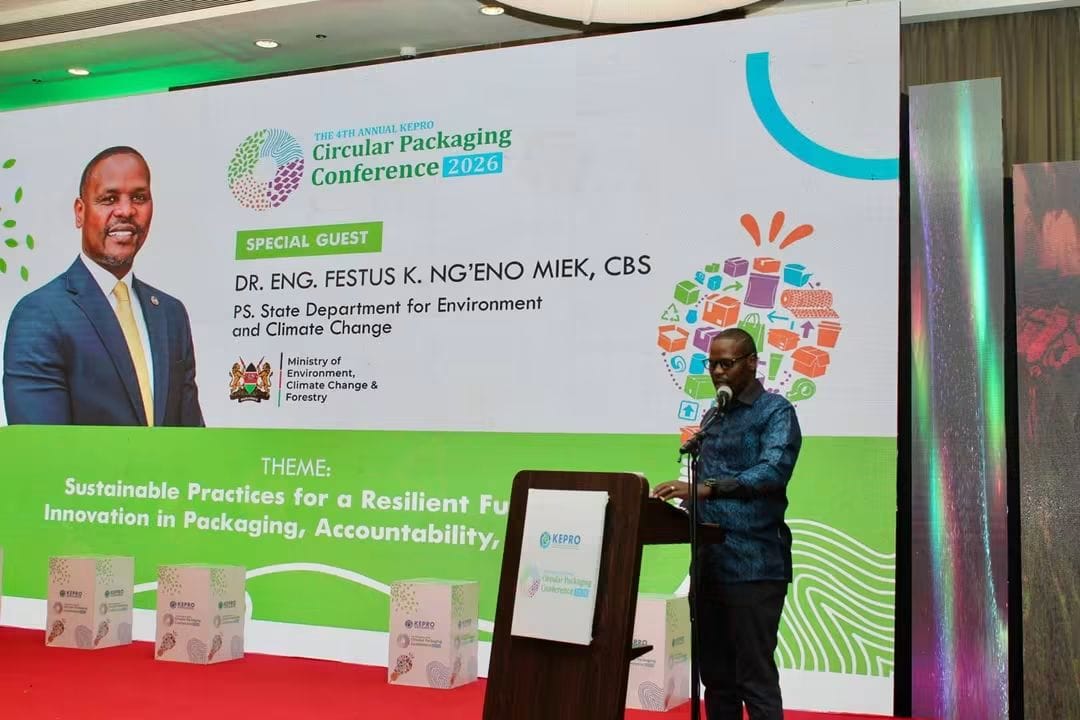
Speaking during the 4th KEPRO Annual Circular Packaging Conference (KACPC IV) held at Hyatt Regency Westlands, Nairobi, the Principal Secretary for Environment and Climate Change, Dr. Eng. Festus K. Ng’eno, reaffirmed the Government’s commitment to transitioning from the traditional linear economy to a circular model that prioritises waste prevention, reuse, recycling and sustainable production.
The conference, themed “Sustainable Packaging for a Resilient Future: Innovation. Accountability. Impact,” brought together government representatives, industry players, recyclers, innovators and development partners to explore practical solutions for advancing sustainable packaging in Kenya.
Dr. Ng’eno noted that packaging waste remains a major environmental challenge, accounting for nearly 30 per cent of the country's domestic waste, with plastics, paper and cartons contributing significantly to the growing waste burden.
He emphasised that the Sustainable Waste Management Act, 2022, and the Extended Producer Responsibility (EPR) Regulations, 2024, provide a strong legal foundation for holding producers accountable for the environmental impacts of their products and packaging throughout their lifecycle.
The Principal Secretary outlined three strategic priorities for accelerating Kenya’s circular economy transition: innovation in sustainable packaging, accountability across the value chain, and inclusive environmental and economic impact.
He urged manufacturers to invest in eco-design, reduce unnecessary packaging materials, promote reuse and recyclability, and support home-grown green innovations.
Dr. Ng’eno further called for transparent reporting, credible data systems and strengthened compliance monitoring to ensure that Extended Producer Responsibility delivers measurable environmental and economic benefits.
He stressed the importance of creating green jobs, strengthening recycling enterprises and improving the livelihoods of waste pickers and informal sector workers to ensure an inclusive and just transition.
The Principal Secretary disclosed that, alongside the finalisation of CESIP, the State Department is developing a National Circular Economy Programme (NACIP) to operationalise the strategy, stimulate green investments and mainstream circularity across key economic sectors.
He challenged producers, county governments and recyclers to jointly invest in modern material recovery facilities, while urging financial institutions and development partners to develop innovative green financing mechanisms to support circular economy enterprises.
Dr. Ng’eno commended the Kenya Extended Producer Responsibility Organisation (KEPRO) for its leadership in promoting sustainable packaging, strengthening recycling systems and mobilising private sector participation in environmental conservation.
He reaffirmed the Government’s commitment to working with KEPRO, the Council of Governors, county governments, industry associations and financial institutions to create an enabling environment for circular economy investments.
The conference provided a platform for strengthening cross-sector partnerships, promoting sustainable packaging innovations and advancing Kenya’s transition towards a cleaner, greener and more resource-efficient economy.